The member, through your frontline
Senior Shield
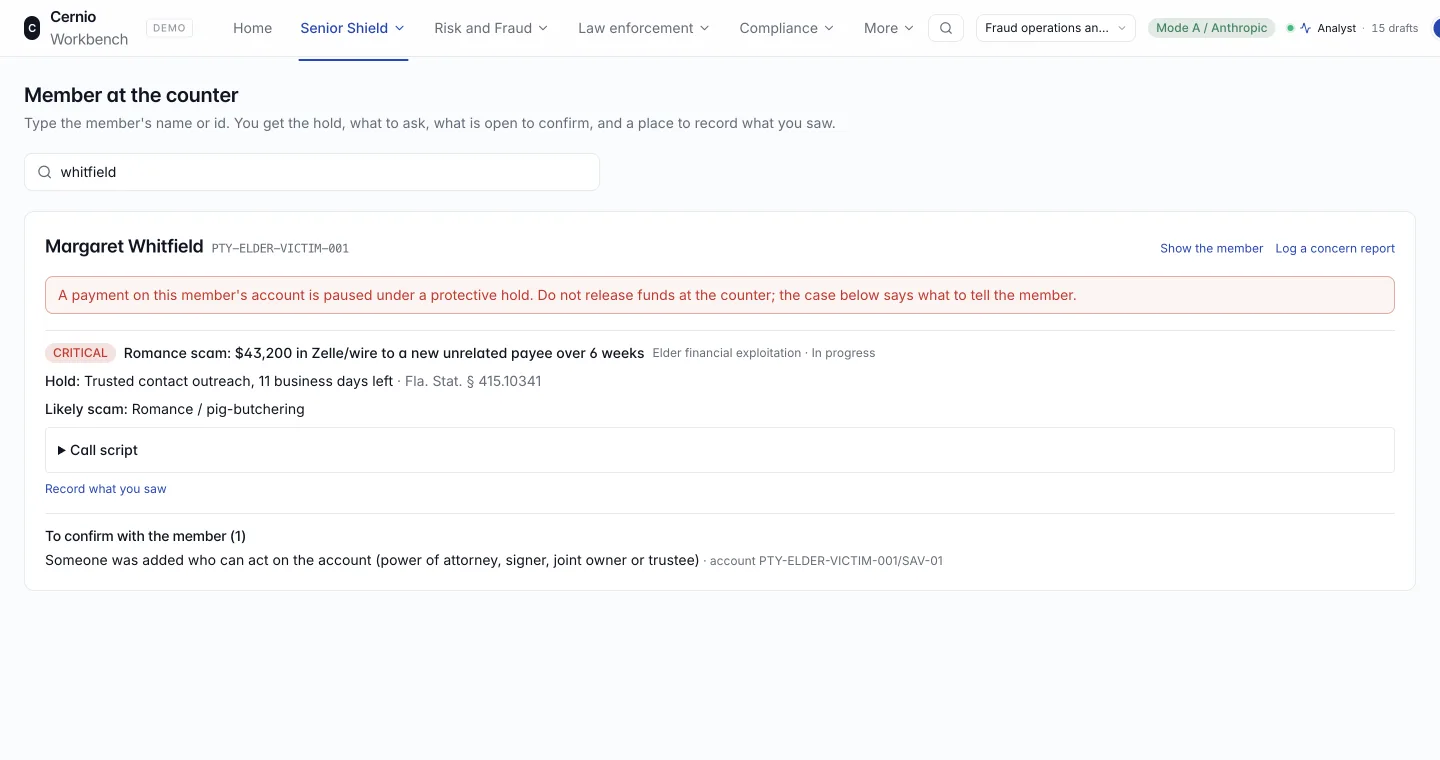
A teller sees the hold and what to ask.
- Member at the counter: the hold and the likely scam
- A plain-language page for the member
- Trusted contacts and concern reports in one place
Cernio checks a payment and its payee before the money goes. It answers release, hold or call the member, with the evidence attached.
One check on the member, the payee and the payment. One answer, with the reasons.
Sanctions and watchlists, and people and firms named on government scam-warning lists.
Phone numbers, email addresses, websites and crypto wallets tied to a sanctioned or warned-about party.
A new payee or a first payment, or a trusted-person change such as a new power of attorney or joint owner, read against the member's own history.
Every answer lists the signals behind it, where each one came from and what it may be used for, and Cernio keeps that record. Apart from a sanctions match, a single outside hit never holds a payment on its own.
Strangers are behind about four in five elder exploitation cases (FinCEN, 2024). When the suspect is a trusted person, the average loss is about $50,000 against $17,000 for a stranger (CFPB elder exploitation SAR analysis).
A new signer or agent, then spending above the member's own baseline.
Contact details or direct deposit changed first.
Relationships sit in the case file beside the transactions.
“There has been a lot of focus on scams, rightfully so, but that’s a piece that people are missing right now … that trusted person.”
The member conversation, the case record, state hold-law guidance and a SAR draft for a person to review and file. One case record, three front doors.
A teller sees the hold and what to ask.
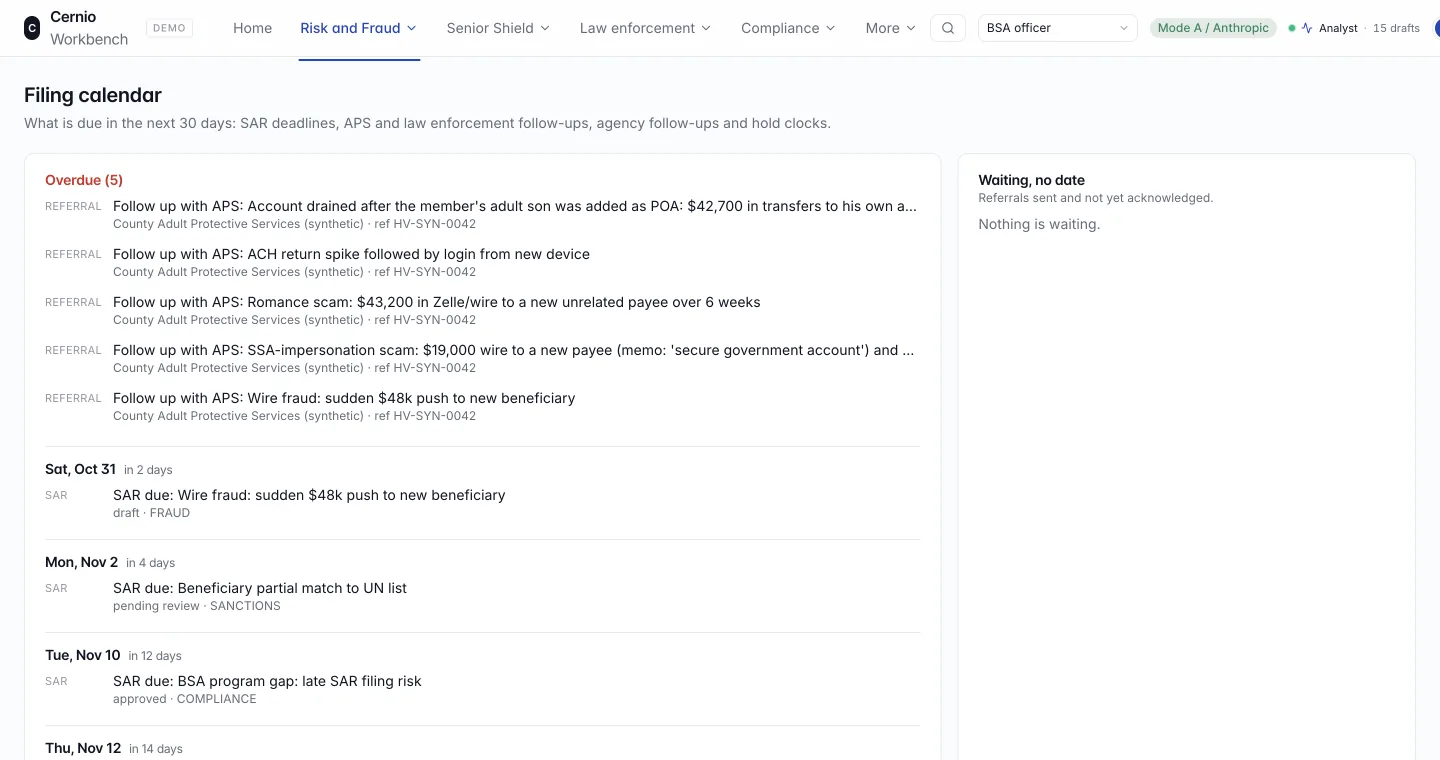
From alert to a filed, acknowledged SAR.
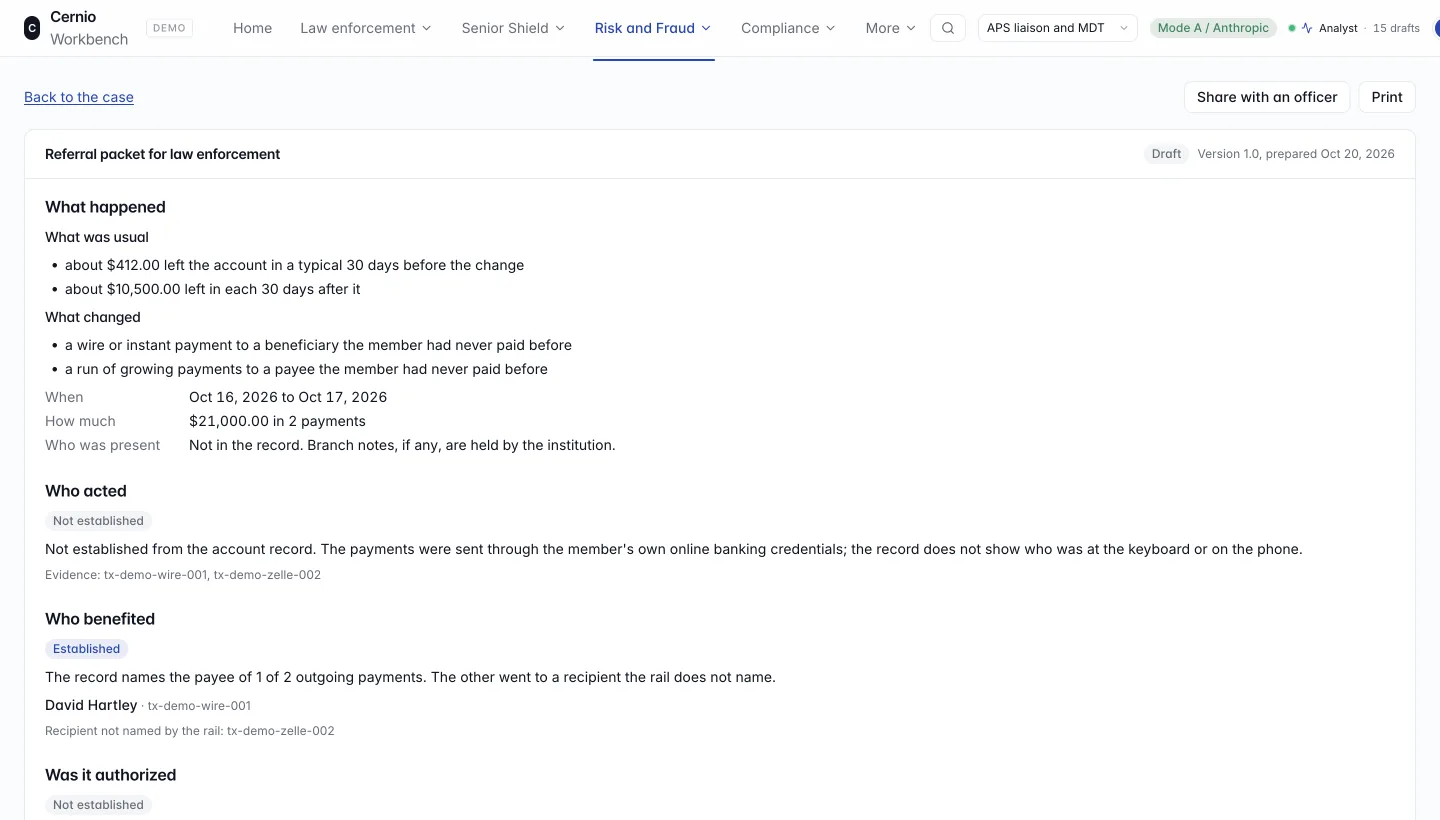
A packet that answers who acted and who benefited.
“Looking at the APS and law enforcement side too is unique. Not a lot of vendors do that.”
One alert, put together as a filed SAR.
From alert to a SAR your team reviews and files, on the core you already run.
FinCEN's User Test system accepted a SAR batch and acknowledged the SAR with a BSA ID.
FinCEN-assigned identifier from the User Test system, recorded on the case by Cernio.
The payment and its payee, against scam and sanctions signals and the member's own history, including a new payee or a new power of attorney or joint owner. Beyond scams and elder exploitation, Cernio covers veterans exploitation, account takeover and benefits fraud, with sanctions screening, SAR and CTR filing, and AML and BSA monitoring on the same engine.
It can slow the payment down, talk with the member again and document the decision, within what its state hold law allows. Cernio shows the teller the hold and what to ask, and keeps the conversation, the decision and any referral on one case record.
Hold laws are set state by state. Cernio shows which state hold law applies to the case in front of the team. The kit includes a state quick reference, which is a reference and not legal advice.
Cernio sits beside the fraud tools you already run, on the core you already have. Those tools look for the stranger. Cernio also watches who the member trusts, such as a newly added power of attorney, joint owner or caregiver.
Cernio runs single-tenant, either in the institution’s own cloud or on a dedicated instance hosted by Adalma. It reads the core and never changes member data. Nothing trains on member data.
Cernio drafts the SAR narrative from the account record. A person at the institution reviews, attests and files it.
US credit unions and community banks. Senior Shield serves the frontline, Risk and Fraud serves analysts and the BSA officer, and the referral desk serves law enforcement and APS.
A few lines is enough. We reply within one business day.
Book a callPartners: hello@adalma.ai